Horses have a knack for getting their legs inevitably caught in something, which usually leads to thrashing, bolting, and injury. Training a horse to wear hobbles can often translate to handling situations in the pasture or around the farm much more calmly than you’d expect.
Hobble training can have a bad reputation, depending on who you ask. If you don’t prepare and educate your horse well enough before slapping a pair on, you’re fixing to have a good sized wreck.
When done correctly, hobble training can be a life-saving skill for a horse and its rider in more ways than one. The process of hobble training allows a horse to think through pressure rather than reacting and causing injury.
Disclosure: this article contains training tips derived from extensive supervision and mentorship under a professional trainer. Please do not attempt at home unless you have extensive training experience or are under the advisement of an experienced equestrian mentor or trainer. Horse training is inherently dangerous and serious injury or death can happen at any time
Hobble training starts with timing and feel, establishing a connection with your horses’ feet and mind. Putting hobbles on your horse is the last step in the process. Each horse learns at its own pace. As long as your signals and releases are consistent, you can help your horse learn a new life skill that may save you both in the future.
Why Bother?
If you’ve ever seen a horse first experience getting their head, foot, leg, or tail stuck or tangled in something, usually there is some sort of thrashing that occurs. Sort of similar to how we flap our arms when we walk through a spider web.
Correct hobble training:
- Allows you to keep your horse nearby even if you don’t have a place to tie
- Is a great opportunity to teach about pressure and release
- Helps build a bond of trust between you and your horse
- Gives you another way to communicate intention, direction, and feel
- Teaches that thrashing doesn’t get them out of trouble, but waiting for help will
- Can save you a massive vet bill and serious injuries
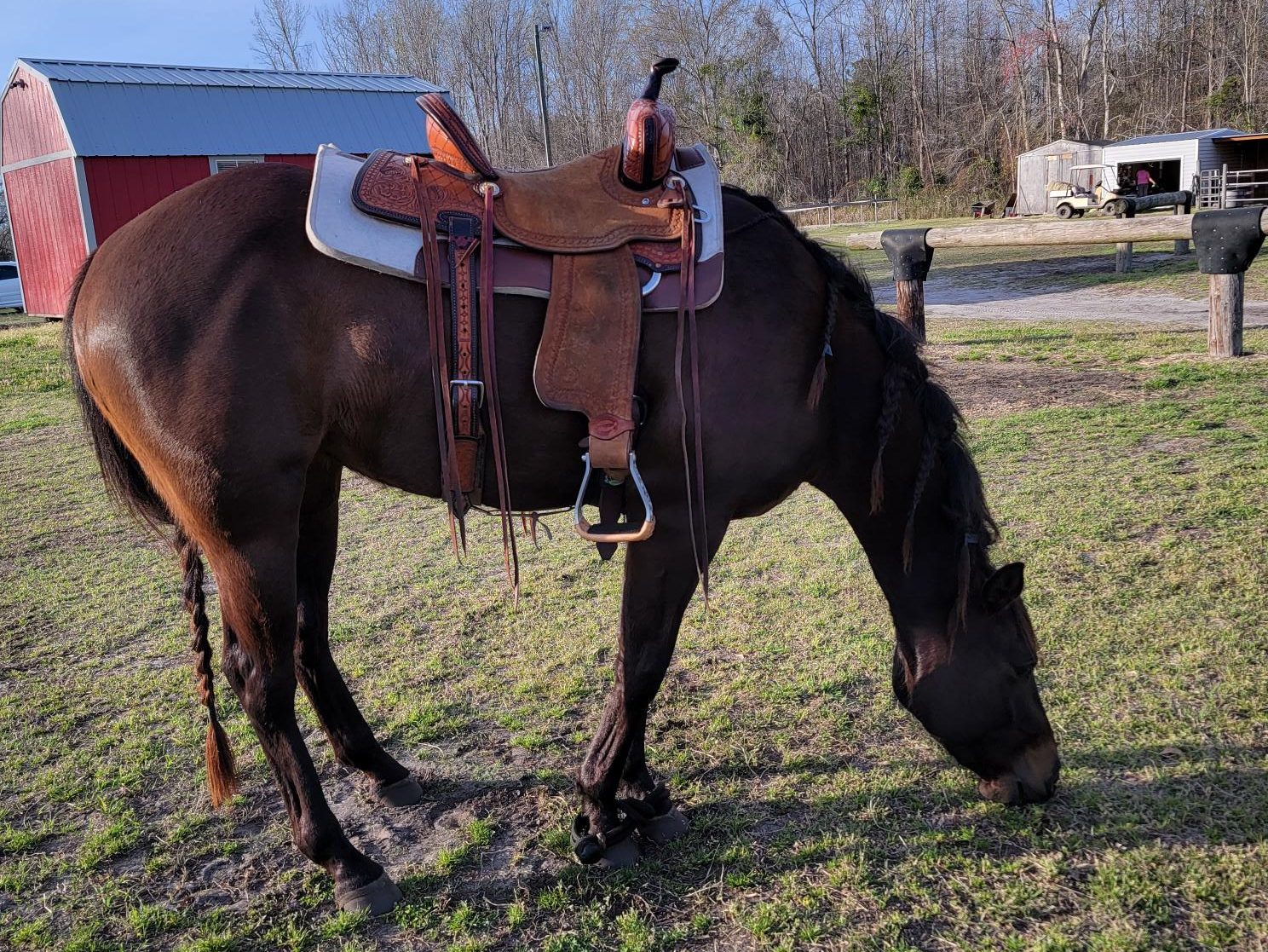
Hobble Training
Before you train your horse to wear hobbles, your horse must understand signal, feel, and release. A signal is some input of energy from you to your horse to indicate a request. Feel gives the signal meaning, release gives it direction.
You must feel the horse acknowledging and feeling back to you. The release comes last, and the timing of the release is key. Horses learn on the release, and your timing will improve as you practice.
Be particular, don’t be picky.
Buck Brannaman
I ask my horse to move in a particular direction in a particular way; I release that energy when I teach new things to say, “that’s all I wanted,” and go about my business and let them think about that for a bit.
Rope Work
I use either my ranch rope (shout-out 310 Ranch Life) or a leg rope to start my hobble training process. My leg ropes are usually shorter than my ranch rope and out of a thicker diameter yacht line that can prevent burns if things get too western. I’ve used both with success.
I also tend to do this kind of thing in a round pen, though I have done it in a small paddock. The round pen allows a more localized and controlled area to work in (and saves you a lot of walking if you get the rope snatched away from you.)
To get the rope on the foot I’m working on, I prop it up and cue the horse to move forward so their footfalls into my loop. If you simply lay a loop out flat on the ground, you won’t be able to pull it up fast enough to rope a foot.
If my horse isn’t wanting to stand still, that’s alright, I always need to work on my roping skills.

I use the 50′, 10.0mm, 4 strand Uoza Citation from 310 Ranch Life. I rope cattle and horses with it and it’s done them all honest. It has a soft but structured feel. It’s great for building larger loops to drape over your target, too, if you’re into the big loop style of roping like I am.
Get Them Thinking
A horse has to be able to think and process information to learn that information. Reacting isn’t thinking, but responding is. Sometimes you have to work through a reaction to get to a response; the key is to stay consistent.
Taking Up Slack
Once you have a foot roped, take up your slack so that you start to pull on your rope and your horse’s foot. Increase this tension until your horse makes a change (hint: they’re probably going to try and kick it off). Keep this tension consistent until the kicking (anything other than standing still), stops.
When you start taking up slack in your rope, do not stand in it’s direct line of pull with the leg. Stand at an angle, otherwise, you will get a nasty rope burn and a bum shoulder.
Once your horse pauses or stops (which may only be for .0003 seconds), immediately put slack back in that rope. This is you offering a feel back to your horse. Ask them to move off around the pen at a walk and pick up your slack again and start over.
If your timing is in tune enough you should see a sharp reduction in the amount of time they spend trying to kick off their new annoying ankle bracelet. Soon after that, you’ll see that when you pick up slack in that rope, they stop their feet.
Leading by Each Foot
Once you have your horse feeling back to you when you take up slack on the rope and you can pick up your horse’s hoof (with the rope), start trying to direct that foot’s placement.
Pick up your slack, stop your horse, pick up that hoof, and pick a very specific spot to place that hoof on the ground. Your horse may immediately pick it up and take it back; that’s okay.
Pick it back up as soon as you can and put it back into that same spot you chose, until the horse moves the other three feet to accommodate your choice in position. Repeat and try to get your horse as soft picking up that foot as you can.
Ta-da, you’re leading your horse by a foot now. Repeat with the other three feet once you have your first one going consistently.
Adding the Hobbles
Only after I have a soft response in all four feet of my horse do I put on their hobbles for the first time.
Some other preferences I have when first hobble training compared to when a horse is a hobbling veteran:
- I usually use cotton or soft hobbles as training hobbles as opposed to more expensive leather.
- I don’t tie hobbles too short at first. Usually, your horse’s shoulder width apart is long enough to start.
- I don’t hobble for hours on end when my horse is first learning. 5 or 10 minutes is plenty for their first time.
- I keep my horse haltered and on a lead line. If everything goes to crap that halter and lead still let me give my horse some structure and direction until they work through a fit.
If I was roping my horse without a halter and lead on, I’ll put that back on before putting on their hobbles. Then I’ll secure the hobbles to the front feet around the fetlock (not cannon bone).
I ask my horse to step one step forward with my lead to let them know they have their hobbles on so they aren’t blindsided if they try to follow when I step away.
Once they feel tension and connection from the hobbles (and if the foundation was laid correctly), your horse should pause and just put that foot down instead of panicking.
At this point, I’ll step a little further away while still holding onto my lead. They might try and pick their other foot up, or both feet up even. If they get fidgety, wait until they settle down and stand still, then take the hobbles off. If your horse isn’t fidgety, wait about 5 or 10 minutes, and take the hobbles off.
Next time, see how they do wearing their hobbles a little longer, then take off their halter and step away, and keep building on that until you have your horse shuffling around the barnyard munching on some tasty new grass.
Closing Thoughts
Hobble training is a fantastic tool when taught correctly and a standard for any of my horses to learn early. Tieing a horse’s legs together without any preparation is what often leads to bone-breaking wrecks, which is why a solid foundation is so important.
Take time to teach your horse what it means to feel something around their fetlock and what to do with that. Stay calm and consistent to help them through it, and you both will come out better on the other side.
Until next time!
 Part-Time Cowpoke