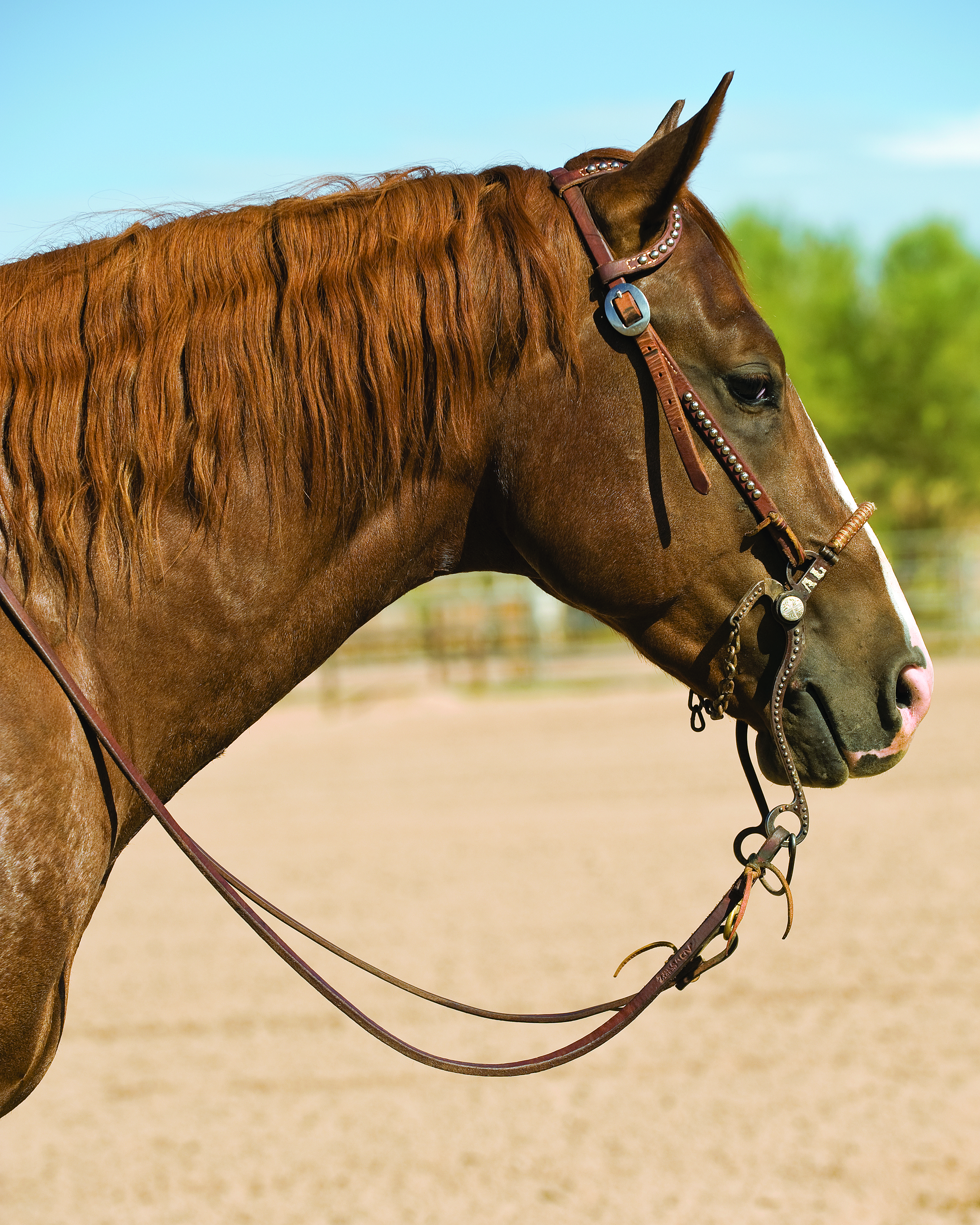
There are so many rigs and headstalls and bridles out there that people use for their horses. Depending on the discipline, you might have two or three different styles for a weekend of shows.
I’ve recently been riding in a simple snaffle rig, but I prefer to ride and train in a hackamore. A hackamore is rich in history, works off of a feel, and is a developmental tool for a horse’s education for years as a part of a deep horsemanship tradition.
The kind of hackamore I’m talking about is very different from a mechanical hackamore. A mechanical hackamore is a bitless bridle that works on pressure and leverage against the bridge of the nose, usually with shanks, with separate left and right reins.
The mechanical hackamore is typically paired with a chin strap or chin chain and mechanically tightens around the mouth as the reins are engaged to squeeze from the bridge of the nose and the underside of the jaw.
The Traditional Hackamore
The hackamore is a term to describe a particular rig used rather than a specific piece of equipment. The rawhide hackamore comprises a bosal, mecate, and bosal hanger. The bosal is a stiff braided loop, often with nose buttons, with a rawhide core varying from 5/16″ to one inch in diameter.
3/8″ and smaller diameter bosals are considered bosalitas and strictly used for training into the two-rein. A pencil bosalita is considered a sign of that particular horse being straight up in the bridle and a very high honor. In this instance, the pencil bosalita is only braided into the forelock and paired with a spade bit, with the primary signal coming from the bit rather than the bosalita.
A Rich History
The history of this intricate piece of equipment has roots deep in Californio and Vaquero horsemanship styles and has had past renditions traced back to as early as 711 AD (called the hackma), as just a rawhide loop around the nose of the horse, often used by the Moors.
This progressed to the Serreta, used by Spaniards. This equipment was placed around the bridge of the horse’s nose and had a serrated edge making contact with the skin, with reins attached to the top of the Serreta. The Serreta developed into the Peruvian bosal (Jaquima) as metal became scarce in the New World.
The Jaquima was made of rawhide but retained the same rein placement as the Serreta. The Jaquima is still used with traditional Paso Fino trainers today. The hackamore, consisting of a bosal, hanger, and mecate, was developed after the colonizing Spanish started larger cattle operations.
The reins (called a mecate) on the hackamore, compared to the Serreta or Jaquima, are attached underneath the chin. This allows the horse to carry a lower headset and keep out of the way of a rope swinging overhead.
Sizes and Mechanics
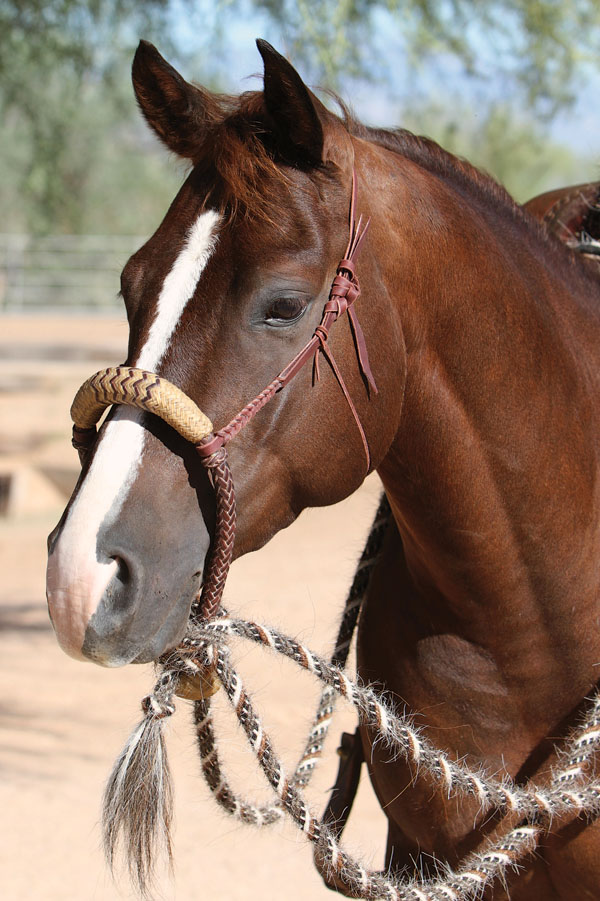
The bosal typically is made no larger than one inch in diameter—this or a 3/4″ diameter or even a 5/8″ diameter is preferred when starting young horses. The larger the diameter, the greater the weight and feel the hackamore has to communicate signals to the horse.
Signal is transferred from the rider’s hands through the reins to specifically placed nose buttons on the hackamore, articulating at either side of the bridge of the nose. The sides of the hackamore assist in reinforcing signal from the nose buttons past a certain level of pressure.
A horse does not progress to a smaller diameter bosal until it is exceptionally soft, responsive, and light to the rider’s signal. Each graduation from bosal size signifies a greater level of training put into the horse wearing it.
When the horse has reached a point in their training to wear a three-eighths diameter hackamore rig, typically, this is paired with a half-breed bit with romal reins; this begins the horses’ training into the two-rein.
A hackamore is fundamentally similar to a snaffle bit when riding with two hands. If a rider needs to firm up on a horse, typically, a bump with the active rein is used, which is a primary technical difference between the two; bumping with a snaffle bit, in the same way, can cause the bit to hit the horse’s teeth causing pain.
The hackamore and the snaffle bit communicate a 1:1 ratio of pressure to signal, meaning if you pick up the rein with five pounds of pressure, the hackamore will translate that same five pounds of pressure to the horse’s face.
For comparison, many bits with shanks (long cheek pieces) and other features often operate on a 1:2, 1:3, or higher pressure ratio to signal, depending on key fulcrum and attachment points. This 1:1 ratio allows the rider to communicate the amount of pressure needed to enforce a signal to the horse.

My New Bosal
Traditional Rawhide Braiders in Fort Worth, TX, just had a sale earlier this year on bosals and accessories such as hangers, mecates, and other traditional cowboy accessories. I absolutely jumped on it and scored a lovely 5/8″, 32-plait bosal with an orange saddle leather hanger.
It came in the mail the other day, and I can’t hardly describe the quality of craftsmanship. The rawhide is finely braided and smoothed, with a great starting shape and symmetry. The orange saddle leather hanger is supple, soft, and will look great against my filly’s darker coat.
I don’t yet have a budget for a horse hair mecate and don’t want to sacrifice my current horse’s tail, so I’m going to use the yacht rope mecate off of my snaffle rig when I transition my filly over. I can’t wait for my filly to wear her new rig and can’t thank Traditional Rawhide Braiders enough for a quality working product that I can enjoy for decades to come.
What’s So Different?
This kind of equipment isn’t like trying a new saddle or a new style of stirrup. The hackamore holds an immense depth of history, tradition, and style of horsemanship. The hackamore cannot control the horse physically, and it wasn’t designed to.
Its premise lies in communication through the whole body-rider to horse; the mentality that the signal originates with a thought and travels down to become so light these signals eventually become invisible. Using a hackamore inherently demands understanding its past, cultural influence, and traditions.

 Part-Time Cowpoke