Equine Gastric Ulcer Syndrome (EGUS), or just “ulcers” to many horse owners, has been a buzzword that’s risen through web search ranks in recent years. Now it seems to even be the new “hush” word around the barn, second to strangles.
Environment, workload, diet, and even a horse’s personality can all lead to your horse developing ulcers. Ulcers often cause pain, a dull coat, weight loss, lack of appetite, behavioral changes, and even mild colic episodes.
Diet was a primary variable isolated in early studies; now, we know EGUS can’t be isolated to one variable. There are ways to help support your horse and prevent and heal serious ulcers through changes in environment or routine, as well as supplements that can help and are backed by research.
Disclaimer: This information is not to be used to diagnose or treat a medical condition or provide veterinary advice. If you suspect your horse has a medical condition such as gastric ulcers, don’t hesitate to get in touch with your veterinarian for evaluation, assessment, and treatment if needed.
Does My Horse Have Ulcers?
A veterinarian diagnoses gastric ulcers with an endoscope procedure. An endoscope is a small camera in a long tube that your veterinarian will insert into your horse’s throat and thread deep into the stomach to look at the stomach lining. This is done under sedation.
Besides a clinical diagnostic procedure that can be fairly invasive and costly, your veterinarian may suggest a course of treatment for ulcers based on your horses’ symptoms.
The most common symptoms of horses with ulcers are:
- Walking away from grain (not finishing meals or preferring hay over grain).
- Biting at their sides or mild colic symptoms such as rolling.
- A dull coat.
- Weight loss.
- An overall look of discomfort.
- Behavioral changes (over-reactivity, food aggression, extra spookiness or blow-ups).
- Cinchiness or bucking under saddle, general discomfort around the girth area.
How Do Horses Get Ulcers?
It turns out horses are pretty finicky (my wallet can attest to that, as can my Vet). Ultimately ulcers are caused by stress. Stress can look different for each horse, similar to how different things stress humans.
Ulcers usually show up in the stomach and are directly a result of stomach acid erosion; some can even form lower in the digestive tract.
The 4 most common variables that can cause ulcers are:
- Change in the environment (hauling, showing, transporting to a new barn).
- Physical stress (training, new pasture mates, weather or traumatic events).
- Not enough constant grazing (those on limited turnout or don’t have access to hay).
- Exercise on an empty stomach or high-performance jobs.
Changes in Environment
Horses (like most humans) like a routine. Routines help horses feel secure and safe and know what’s predictable in their environment. Horses can experience stress during environmental changes, which can lead to the development of ulcers.
Depending on how sensitive your horse is, it may or may not be bothered by changing pastures, feeding routines, barns, show travel, or even walking to a new area of the property.
Now, these things are inevitable at some point; a horse has to learn to tolerate these changes to live in the human world. However, if we are aware our horses may be uncomfortable, then we can help prevent extended discomfort during those stressful events.
Physical Stress
Physical stress is one of the most prominent sources of an ulcer flare or initial ulcer issue. Changing pasture-mates, a change in the pecking order in an established group (which can actually happen multiple times a day), starting intensive training (colt starting or advanced training in a discipline), or even weather events can trigger enough stress to cause one, or a few, ulcers.
Not Enough Grazing
Horses are built to graze most of the day. Horses also produce a significant amount of saliva when grazing and eating, which is alkaline in nature.
Stomach acid has a very high acidity level; therefore, a horse’s saliva acts as a buffer to the stomach acid. The saliva neutralizes some of the acidity for most of the day while still allowing all that roughage to be digested well.
Grazing on grass and hay also allows the roughage to form a sort of blanket that sits in the stomach, preventing splashing during activity and movement that often occurs when the stomach is empty.
When a horse cannot graze, saliva isn’t produced as much to act as this buffer, which means the stomach acid pH stays high throughout the day, slowly eating at the stomach lining when the horse moves around.
High-Performance Jobs
There’s no question that horses with high-performance and high-stress jobs often end up with ulcers at some point in their lives. 90% or more of racehorses and about 60% or more of show horses experience ulcers. This is why appropriate gastric support and interventions recommended by your veterinarian are so important.
So Now What?
Always contact your veterinarian first to understand what might help your horse the best. After that, it’s always good practice to educate yourself enough to understand what your veterinarian is telling you. You can feel more confident moving forward with their recommended treatment approach.
Understanding how the horse’s stomach works is foundational. Then we can look into how different treatment and prevention strategies act on this part of the body to help treat ulcers and make your horse more comfortable.
The Stomach
A horse’s stomach is made of two different kinds of tissue (which leads to different types of ulcers, but more on that later). The lower part of a horse’s stomach is made of glandular mucosal tissue and produces digestive acid.
Stomach Tissue
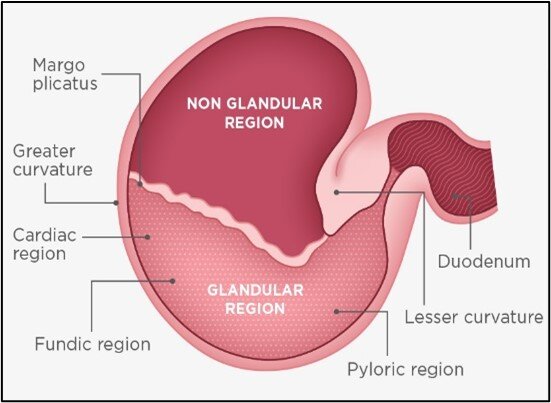
Naturally, this tissue has protective factors against the low pH of these juices (though it’s not immune to ulcers of its own, called glandular ulcers). The upper lining of the stomach is made of squamous mucosal tissue, and this has no protective factors against stomach acid if levels increase or acid levels splash into this region.
Most ulcers are found in the non-glandular region, where stomach acid splashes and burns this tissue. Other ulcers are found in the glandular region of the stomach, and there’s limited information about why this area develops ulcers. Treating glandular ulcers is much more difficult than nonglandular ulcers.
Stomach Acid
A horse produces stomach acid (hydrochloric acid) 24 hours a day, seven days a week. This is to complement the horse’s style of eating, which is to graze and digest most waking hours, and this doesn’t just “turn off” if a horse isn’t eating at that moment.
One horse can produce up to 16 gallons of hydrochloric acid a day. This acid is so caustic that when the horse eats, saliva (containing bicarbonate compounds) production increases and acts as a buffer to increase the pH within the stomach.
Prevention and Support
Preventing ulcers is the best way to help minimize discomfort for your horse, especially if they have already been diagnosed and treated for ulcers in the past. There are a few FDA-approved medications for prevention, some well-researched diet changes that can be made, and some products that are more up-and-coming but not extensively studied yet.
Alfalfa
Alfalfa has been studied and found to act as an antacid for horses. With hay prices nowadays, this probably isn’t the most economical option, but it’s been empirically proven to help. This can be fed as a total hay switch or preemptively before a stressful event or workout.
Alfalfa hay also helps create that netting of roughage right before exercise that helps reduce stomach acid splashing around and eating away at the upper lining of the stomach.
Omeprazole
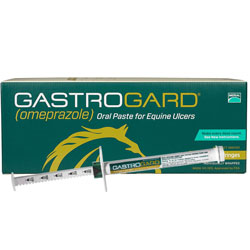
Yep, just how it reads, it’s the same stuff in human prescription antacids. Omeprazole can be prescribed by your veterinarian in powder form or bought over the counter and is the only FDA-approved pharmaceutical to treat equine ulcers. GastroGard® is the most common omeprazole paste that’s been heavily researched for the effectiveness and prevention of ulcers.
Many vets will recommend using UlcerGard® as a preventative as well, with general directions to begin administering the once-daily dose 48 hours before a stressful event. UlcerGard® is the over-the-counter formula of GastroGard® and is intended as a preventative.
Why GastroGard® is unique in the realm of omeprazole supplements is that its formula is patented to deliver the most omeprazole to the stomach as possible. In contrast, other supplements may break down prematurely before reaching the stomach lining.
Omeprazole works by inhibiting the proton pumps responsible for producing stomach acid. Of course, this doesn’t eliminate stomach acid production totally; horses can still digest everything they need. This does not specifically heal the ulcered areas directly but does allow the body to quickly heal any ulcers that have developed and decrease discomfort.
There are some other prescription compounds your veterinarian may prescribe, like sucralfate or misoprostol. Misoprostol is another compound also used in some human medical conditions.
GastroMend®

GastroMend® is a powder supplement developed by Dr. Edwin Simpson and his team at SynNutra Equine. GastroMend® is used as a top dressing in feed or can be mixed with water for a syringeable solution.
This supplement is designed to promote the healing of ulcered areas through stimulating fibronectin and collagen production.
SynNutra Equine states this product does not alter the stomach acidity or production of stomach acid and can be used as a preventative or for the treatment of ulcers. SynNutra Equine also boasts that none of their products contain banned substances, for those that show extensively at high levels.
Purina® Outlast®
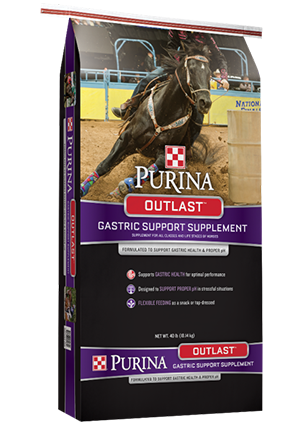
Purina® Outlast® is a specially formulated feed supplement designed by top-tier equine nutritionists. It can be fed as a top dressing or as a snack within one hour of a stressful event.
Its formula is designed to support an appropriate pH level of the horse’s stomach acid. Of course, Purina also has a line of gastric support feeds that this supplement falls under.
What’s nice is that this is one of the more affordable options on the ulcer market. As always, discuss any concerns or treatment options with your veterinarian.
Other Supplements
There are quite a few other powders, pellets, liquids, etc., that you can find and try on your own as well. Shoot, some people (ahem, me included) have even used aloe juice to try and give some relief. I had an old horseman I respect very much even tell me he treated ulcers with green (bentonite) clay and chlorella.
The caveat with these kinds of approaches is that you may have heard from so-and-so’s grandpa to try such-and-such because it worked for “generations.” The issue lies in knowing if what you did, worked or if the ulcers healed despite the “treatment.” This is where research helps the most.
Unfortunately, research has limitations, as not everything has been studied and published. Why? Because it costs money, and people don’t just have money laying around to plan, develop, and write a study, much less hire people to help with it.
Routine Changes to Consider to Help Even More
Some other tips that a veterinarian recommended during an equine ulcer seminar our local vet group hosted made a lot of sense.
Part of these included administering UlcerGard® before every suspected stressful event or a constant regimen of GastroGard® (these were representatives of the company). These were sensible people, though, and understood how expensive this product can be.
Others that were a little more feasible for my budget were to feed a third of a flake or so of alfalfa hay before exercise or a training session. They also recommended minimizing the time between feedings; less than 6 hours between feeding concentrates (grains) was best.
Other topics discussed were reducing time in a stall without grazing opportunity, free access to hay if possible, and housing horses together with calm herd dynamics and ample turnout.
Of course, some horses cannot be on full turnout for medical reasons, and these are cases that your veterinarian should already be actively advising.
 Part-Time Cowpoke